
Ten grams of powder cocaine weighs about as much as two U.S. nickels. That is where a trafficking charge begins — for powder cocaine, methamphetamine, and crack cocaine (cocaine base) alike.
For heroin, trafficking begins at four grams — less than the weight of one nickel.
For powder cocaine, methamphetamine, and cocaine base, 100 grams to less than 200 grams carries a mandatory 25-year sentence upon conviction, with no probation and no suspension available.
“Trafficking” does not necessarily mean the State claims someone sold drugs. Under South Carolina law, knowing actual or constructive possession of the statutory quantity can itself support a trafficking prosecution.
So the first questions in a serious drug case are concrete ones:
What substance did the laboratory identify?
What quantity is the State relying on?
Is the State using the correct statute and weight threshold?
What exactly was weighed — the pure drug or a mixture containing it?
What evidence connects the accused to the substance?
Was the evidence obtained lawfully?
Is the State alleging possession, sale, delivery, conspiracy, or another theory?
Which Statute Applies to Which Drug?
South Carolina does not use one trafficking statute for every controlled substance.
Powder cocaine and heroin are addressed in S.C. Code § 44-53-370(e). Methamphetamine and cocaine base — commonly called crack cocaine — are addressed separately in S.C. Code § 44-53-375(C).
A police report or warrant that simply says “cocaine” does not necessarily tell you which trafficking provision applies. Powder cocaine and cocaine base are legally distinct categories under South Carolina law.
The laboratory identification helps determine which statute applies — and the laboratory conclusion itself can still be challenged.
So one of the first things I want to know in a cocaine case is not simply how much material police seized. I want to know what the laboratory says the substance actually is and whether the charge matches the statute that governs it.
What Are the Trafficking Penalties for Cocaine, Methamphetamine, and Crack?
Powder cocaine is governed by S.C. Code § 44-53-370(e)(2). Methamphetamine and cocaine base are governed by S.C. Code § 44-53-375(C).
Although they arise under different statutes, the current trafficking weight tiers and penalties are substantially the same:
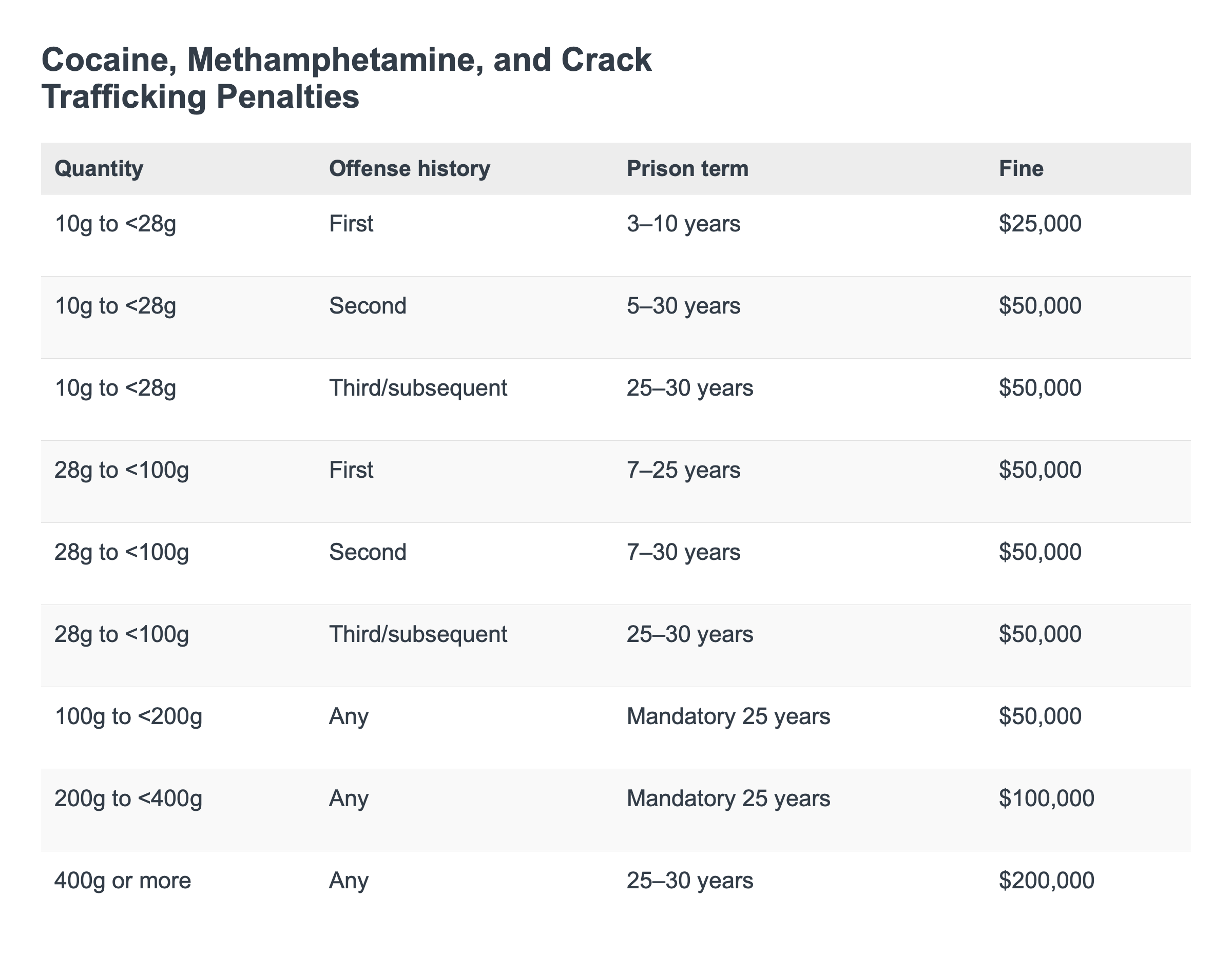
Where a range in the table begins at 25 years, 25 years is the mandatory minimum. The applicable trafficking statutes also prohibit suspension of the sentence and probation.
Identical penalty ranges do not make powder cocaine and cocaine base interchangeable. The substance the State can prove determines which statutory framework applies.
What Are the Trafficking Penalties for Heroin?
Heroin falls within South Carolina's “trafficking in illegal drugs” provision, S.C. Code § 44-53-370(e)(3).
Trafficking begins at four grams of heroin or another substance covered by that statutory provision, including a qualifying mixture.
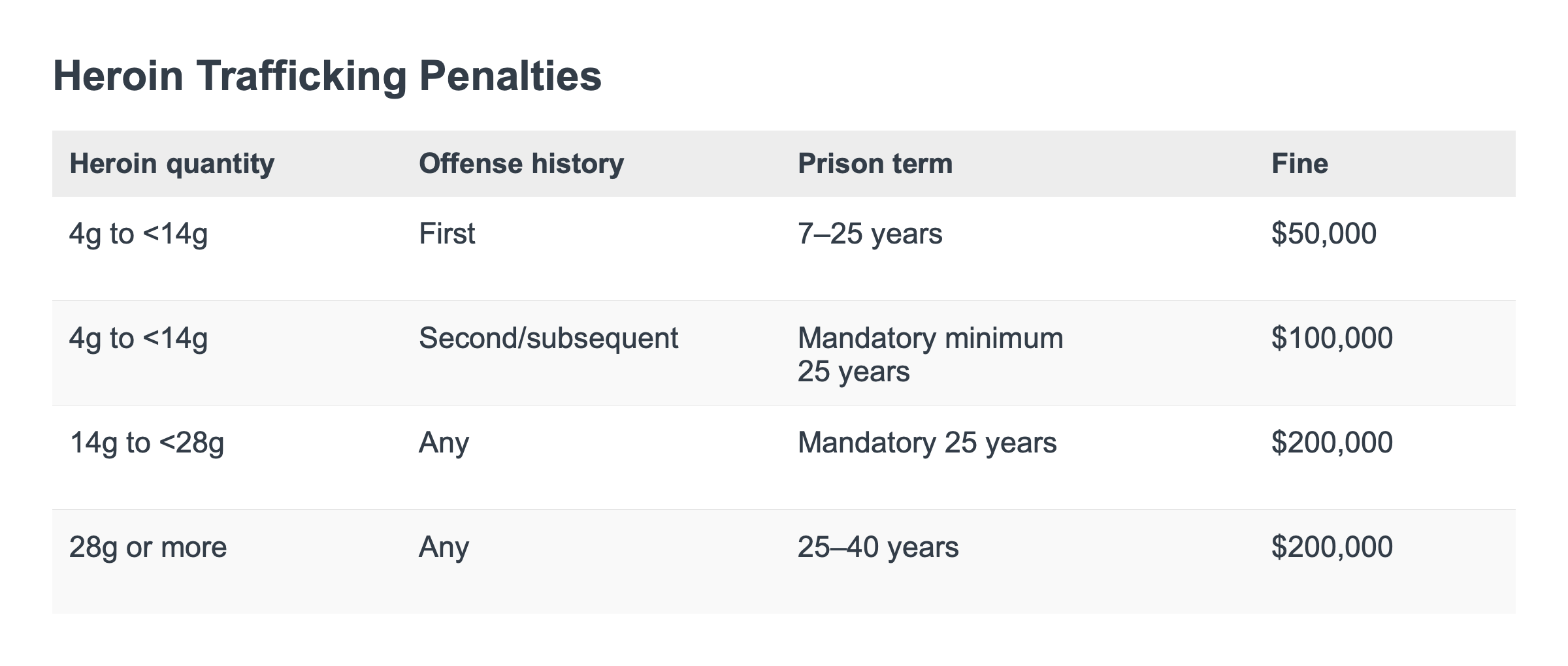
The statute prohibits suspension and probation for these trafficking sentences.
Penalty provisions in the tables above are stated as of November 2026. Drug statutes can change and should be checked against the current South Carolina Code.
These are statutory ranges, not predictions about a particular case. Prior-offense rules, release restrictions, and other sentencing provisions can materially change the practical consequences of a conviction.
How Do the Trafficking Thresholds Compare?
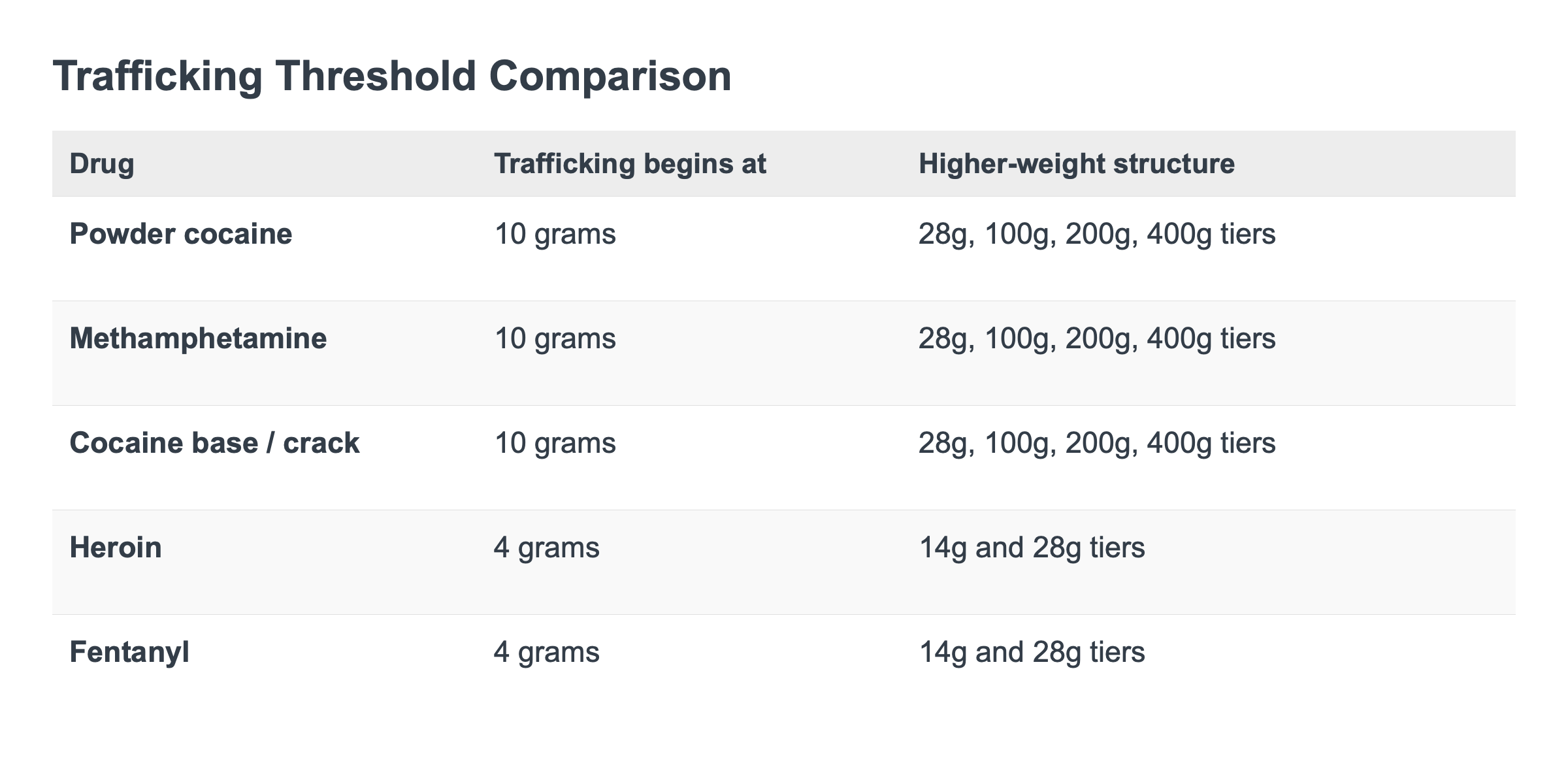
The number on the scale means very different things depending on the drug.
And this is one of the first places I look when reviewing a trafficking case:
Did the State identify the drug correctly, charge under the correct statute, and place the alleged weight in the correct tier?
If the substance is cocaine base but the charge proceeds under the powder-cocaine provision, that is more than a labeling problem — the State may be proceeding under the wrong statutory framework.
For a detailed discussion of fentanyl-specific thresholds, mixture weight, and overdose issues, see Fentanyl Trafficking Charges in South Carolina: Weight Thresholds, Penalties, and Defenses.
Does the Weight Include a Mixture?
Yes, depending on the drug.
For powder cocaine and heroin, § 44-53-370 expressly includes the controlled substance in pure form or in a compound or mixture.
Methamphetamine is also defined broadly. S.C. Code § 44-53-110(28) defines “methamphetamine” to include any salt, isomer, salt of an isomer, or any mixture or compound containing amphetamine or methamphetamine.
So a ten-gram methamphetamine trafficking allegation does not necessarily mean the State claims there were ten grams of chemically pure methamphetamine.
That makes the laboratory work important. I want to know:
What was actually weighed?
Was packaging excluded?
Which packages or samples were tested?
Does the laboratory result correspond to the quantity the State relies on?
If only some material was tested, what supports treating the rest as the same drug?
The number in a police report is a starting point. I want to know what was actually weighed and what the laboratory actually tested.
Why Weight Is Only Part of the Case
A weight at or above the statutory threshold does not by itself prove that a particular defendant committed trafficking.
In a possession-based case, the State still needs evidence connecting the accused to the drugs. When drugs are found in a shared vehicle, residence, hotel room, bedroom, or container, the issue may become whether the State can prove actual or constructive possession rather than simply presence near the drugs.
And possession is only one trafficking theory. Depending on the statute and facts, the State may rely on sale, delivery, purchase, aiding and abetting, attempt, conspiracy, or other covered conduct.
That means a defense focused only on “those were not my drugs” may not answer the case if the prosecution is proceeding on a delivery, conspiracy, or other non-possession theory.
The first question is therefore not merely:
“How much did the drugs weigh?”
It is:
“What exactly does the State claim this defendant did, and what evidence proves it?”
What About Searches, Informants, and Cooperating Witnesses?
Many trafficking prosecutions grow out of traffic stops, search warrants, controlled purchases, surveillance, confidential informants, or cooperating defendants.
I want to know whether law enforcement obtained the evidence lawfully. If the case depends on a cooperating witness, I also want to know what that person actually knows, what the witness may be getting in return, and what independent evidence confirms the account.
I discuss search, informant, and cooperating-witness issues in more detail in the fentanyl-trafficking article.
Can Prior Drug Convictions Increase the Penalty?
Yes.
At the lower trafficking tiers for cocaine, methamphetamine, cocaine base, and heroin, prior offense history can substantially increase the sentencing range.
That does not mean every prior drug conviction automatically counts.
S.C. Code § 44-53-470 governs when a prior controlled-substance conviction qualifies as a prior offense.
Whether a prior conviction counts can depend on both the type of conviction and when it occurred. For some prior convictions, the statutory period can run from the person's release from confinement rather than simply from the conviction date.
For that reason, criminal-history analysis should happen early rather than waiting until plea negotiations are nearly complete.
Which Trafficking Convictions Are No-Parole Offenses?
South Carolina classifies all of the trafficking offenses discussed in this article as violent crimes under S.C. Code § 16-1-60.
But violent-crime classification and no-parole classification are separate questions.
A first offense involving 10 grams to less than 28 grams of powder cocaine, methamphetamine, or cocaine base carries a maximum sentence of ten years and does not qualify as a no-parole offense under S.C. Code § 24-13-100 on that basis.
The other trafficking tiers listed in this article qualify as no-parole offenses under § 24-13-100 because they are either Class A, B, or C felonies under § 16-1-90 or qualifying offenses exempt from classification under § 16-1-10(D).
For convictions that qualify as no-parole offenses and result in a qualifying term-of-years sentence to Department of Corrections custody, S.C. Code § 24-13-150 generally requires service of at least 85% of the actual unsuspended term before eligibility for the forms of early release covered by that statute.
That does not mean release is automatic after 85 percent. It is an eligibility floor, and other statutory restrictions may still apply.
For a client evaluating a plea offer or possible sentence, the practical consequences therefore depend not only on the weight and sentencing range, but also on which particular tier of the trafficking statute applies.
Where Is a Greenville County Drug Trafficking Case Prosecuted?
A state drug-trafficking charge in Greenville County proceeds through General Sessions Court in the Thirteenth Judicial Circuit.
The same South Carolina trafficking statutes apply throughout the State, although local court scheduling and case-management practices can differ.
For more about how a serious state felony moves through Greenville County General Sessions, see What Happens After a Serious Felony Arrest in Greenville County?.
Could the Case Become Federal?
Yes.
A drug investigation that begins with state or local law enforcement can still lead to federal charges.
Federal drug cases often involve multi-defendant conspiracies, federal agencies, firearms, substantial quantities, controlled purchases, electronic evidence, and cooperating defendants. Those are common features, not prerequisites for federal prosecution.
Federal drug cases also operate under a different sentencing framework, including statutory mandatory minimums, the Federal Sentencing Guidelines, relevant conduct, criminal-history issues, and potentially drug quantities attributed through conspiracy rather than only drugs physically possessed by one defendant.
If DEA, FBI, ATF, Homeland Security Investigations, or another federal agency becomes involved, do not assume the matter will remain in state court.
For more about federal investigations before indictment, see Under Federal Investigation in South Carolina? What to Do Before You Are Charged.
What Do I Look at in a South Carolina Trafficking Case?
When I evaluate a serious trafficking case, the central questions are usually:
Drug identity: What substance did the laboratory actually identify?
Weight: What quantity can the State actually prove?
Correct statute: Is the State using the right trafficking provision and weight tier?
Theory of liability: What exactly does the State claim the client did?
Connection to the drugs: If possession is the theory, what actually connects the client to them?
Legality of the investigation: How did law enforcement obtain the evidence?
Criminal history: Does the State claim a prior conviction increases the penalty, and does it legally qualify?
Federal exposure: Is federal prosecution a realistic possibility?
The point is not to work through a standard checklist simply because the charge says “trafficking.”
It is to identify which issues actually matter in this case.
The Weight Matters, but It Is Not the Whole Case
The sentencing ranges for South Carolina drug trafficking can reach decades in prison, but the number on a laboratory report or arrest warrant does not decide the case.
The State still has to prove what the substance was, how much of it is legally attributable to the charge, what this defendant did, and the elements of the trafficking theory being pursued.
Sometimes that analysis reveals a legal or evidentiary weakness. Sometimes it confirms that the government's case is strong and that the most important work is evaluating risk and resolution.
The weight matters. But the weight is not the whole case.
Frequently Asked Questions
How much cocaine is trafficking in South Carolina?
For powder cocaine, trafficking begins at 10 grams under § 44-53-370(e)(2). For a first offense involving 10 grams to less than 28 grams, the statutory sentence is 3 to 10 years, with a $25,000 fine. The sentence may not be suspended and probation may not be granted.
Cocaine base, or crack cocaine, is governed by a different statute, § 44-53-375(C), but also has a 10-gram trafficking threshold.
How much methamphetamine is trafficking in South Carolina?
Methamphetamine trafficking begins at 10 grams under § 44-53-375(C), the same statute that governs cocaine base. For a first offense involving 10 grams to less than 28 grams, the statutory sentence is 3 to 10 years, with a $25,000 fine. The sentence may not be suspended and probation may not be granted.
How much heroin is trafficking in South Carolina?
Heroin trafficking begins at four grams under § 44-53-370(e)(3). For a first offense involving four grams to less than 14 grams, the statutory sentence is 7 to 25 years, with a $50,000 fine. The sentence may not be suspended and probation may not be granted.
What is the mandatory minimum for drug trafficking in South Carolina?
There is no single mandatory minimum. It depends on the drug, the alleged weight, and, at some tiers, the defendant's qualifying prior convictions.
For example, a first offense involving 10 grams to less than 28 grams of powder cocaine, methamphetamine, or cocaine base has a three-year mandatory minimum.
Many higher-weight trafficking tiers carry a 25-year mandatory minimum.
For heroin, the minimum starts at seven years for a first offense involving four grams to less than 14 grams and rises to a mandatory 25 years at higher tiers or for qualifying repeat offenses.
Is every South Carolina drug-trafficking conviction a no-parole offense?
No.
The classification depends on the particular trafficking tier. A first offense involving 10 grams to less than 28 grams of powder cocaine, methamphetamine, or cocaine base does not qualify as a no-parole offense under § 24-13-100 on that basis. The other trafficking tiers listed in this article do qualify as no-parole offenses.
The 85% rule and its limitations are explained in the no-parole section above.
Does a trafficking charge require proof that drugs were actually sold?
No.
South Carolina trafficking statutes can reach conduct other than a completed sale, including possession of the statutory quantity and other specified trafficking conduct. The particular theory depends on the drug, the governing statute, and the allegations in the case.
If you or a family member is facing a methamphetamine, cocaine, crack cocaine, or heroin trafficking charge in South Carolina, understanding the alleged weight is only the first step. The substance, laboratory evidence, theory of liability, search-and-seizure issues, criminal history, and possible federal exposure may all affect what you are actually facing.
Contact Gibson Law or 📞 Call (864) 241-6699 to schedule a consultation.
This article is provided for general informational purposes only and does not constitute legal advice. Every case is different. Reading this article or contacting the firm through this website does not, by itself, create an attorney-client relationship.